
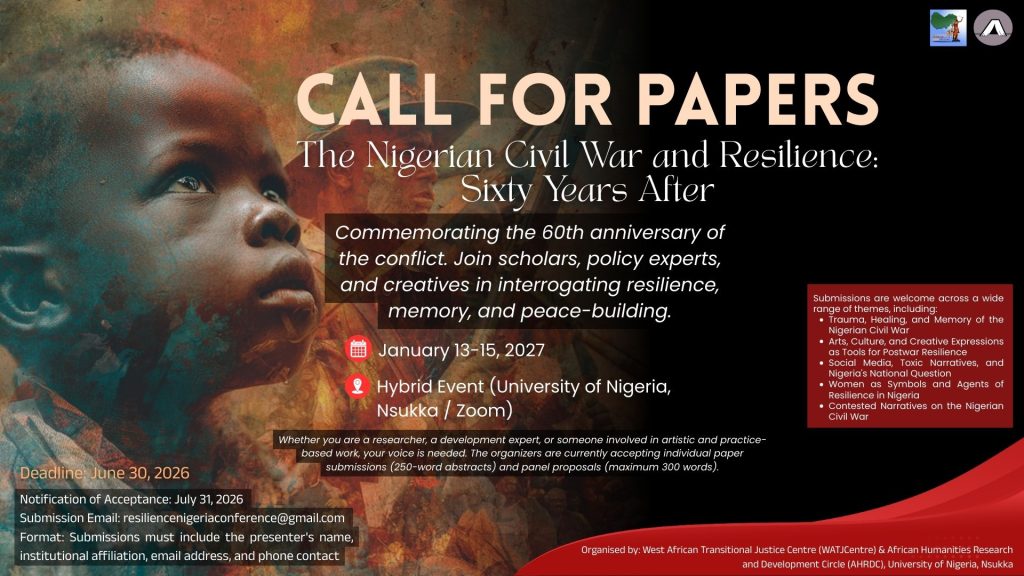
Call for Papers
The Nigerian Civil War and Resilience: Sixty Years After
January 13-15, 2027 (Hybrid: University of Nigeria, Nsukka/Zoom) Abstract Deadline: June 30, 2026
The outbreak of the Nigerian Civil War in 1967-just seven years after the end of colonial rule marked a defining moment in the history of a nation still grappling with the challenges of postcolonial state formation. This period was characterised by deepening political instability, escalating corruption, repeated military interventions in governance through coups d’état, and episodes of mass violence, all of which posed grave threats to peaceful coexistence and national cohesion.
The most pronounced manifestation of these tensions was the secession of Eastern Nigeria, following the declaration of the state of Biafra on 30 May 1967. The ensuing war resulted in extensive loss of lives and properties, alongside large-scale population displacement. Initially, Igbo populations were forced to migrate eastward from other parts of the country, while non-Igbo Nigerians fled the Eastern Region. During the hostilities, however, significant numbers of the Igbo themselves were displaced from their ancestral homeland, with some eventually resettling in refugee camps across different parts of the world.
One living example of the multi-layered displacement occasioned by the civil war, which also intersects with the theme of resilience, is the story of Regina Ubanatu, who rose through disability challenges and displacement in a French-run refugee camp in Libreville, Gabon, to emerge as a force to be reckoned with in advancing the rights of the specially-abled. She serves as a powerful illustration of the resilient spirit that has emerged from the war’s enduring aftermath. Her experience exemplifies the broader capacities for survival, adaptation, and leadership among individuals and communities affected by the conflict. Her lived experiences would be analysed during the conference.
The theme of postwar resilience runs powerfully through both the experience of the Nigerian nation-still navigating persistent political, economic, and security challenges and that of the Igbo people, who have continued to thrive across diverse spheres of endeavour despite the lingering shadow of the Biafra experience. This legacy remains embedded in public memory and continues to circulate through toxic and polarizing narratives, particularly within contemporary digital media spaces.
To commemorate the 60th anniversary of the Nigerian Civil War in 2027, the West African Transitional Justice Centre (WATJCentre) and the African Humanities Research and Development Circle (AHRDC), University of Nigeria, Nsukka, invite scholars, development and policy experts, civil society organisations, among others, to submit proposals for a three-day international conference. The conference seeks to critically examine the Nigerian Civil War as a historical event and as a continuing site for interrogating resilience, memory, citizenship, identity, governance, and peace-building in Nigeria and Africa more broadly.
The conference will mainstream the variegated legacies of the civil war, which include: individual, group and national resilience ; contemporary national and international realities that derive from or mirror the conflict, among others. Well-researched presentations should provide content for and address the plethora of conflicting narratives circulating in the public space.
Conference Themes:
Scholars are invited to submit proposals on the following themes and related topics:
- Trauma, Healing, and Memory of the Nigerian Civil War.
- Biafra and the Citizenship Question in Nigeria.
- Civil Wars and Resilience in Africa.
- The Igbo Presidency Question Sixty Years after the Nigerian Civil War.
- Arts, Culture, and Creative Expressions as Tools for Postwar Resilience.
- The Role of the Intellectual in Building and Sustaining Peace in Nigeria.
- Rethinking Federalism: Viable Models for Nigeria.
- Social Media, Toxic Narratives, and Nigeria’s National Question.
- Women as Symbols and Agents of Resilience in Nigeria.
- Migration, Displacement, and Postwar Recovery.
- Global Power Dynamics and the Question of Sovereignty in a Changing World Order.
- Political Order, Religion, and Resilience
- Traditions and Rituals of healing and resilience
- Economic Resilience and recovery
- Collective and Civic Activities for post conflict reintegration
- The Elastic limits of healing and resilience
- Contested Narratives on the Nigerian Civil War
- “No Victor, No Vanquished” and the challenges of healing and resilience
- Reconciliation, Reconstruction and Rehabilitation towards resilience-building
Submission Guidelines The conference welcomes individual paper submissions and panel proposals. Individual submissions should include a 250-word abstract, clearly stating the paper’s argument, methodology, and contribution. Abstracts should be accompanied by the presenter’s name(s), institutional affiliation(s), email address(es), and phone contact(s).
Panel submissions may include traditional panels, roundtables, workshops, or artistic and practice-based panels relevant to the conference themes. Panel proposals should not exceed 300 words and must include the panel title, abstract, and a list of participants with their affiliations and contact details.
All submissions shouldbesentto: resiliencenigeriaconference@gmail.com Submission deadline: 30 June 2026. Notification of acceptance: 31 July 2026.
Conference Registration Fees:
- N5,000 for Nigeria-based participants (Participation for Masters and undergraduate students is free).
- $50 for participants from other African countries.
- $100 for participants from outside Africa.
The fee covers conference materials, tea breaks. Accepted participants will be required to pre-register by 30 November 2026, to facilitate effective logistical planning.
For partnerships and further inquiries, please contact: resiliencenigeriaconference@gmail.com (cc: violetikong@gmail.com and chisomuchendu123@gmail.com).